

Home poker tracking
How to Track Poker Buy-Ins and Cash-Outs
Keep every poker night organized with a simple ledger for money in, money out, and final settlement.
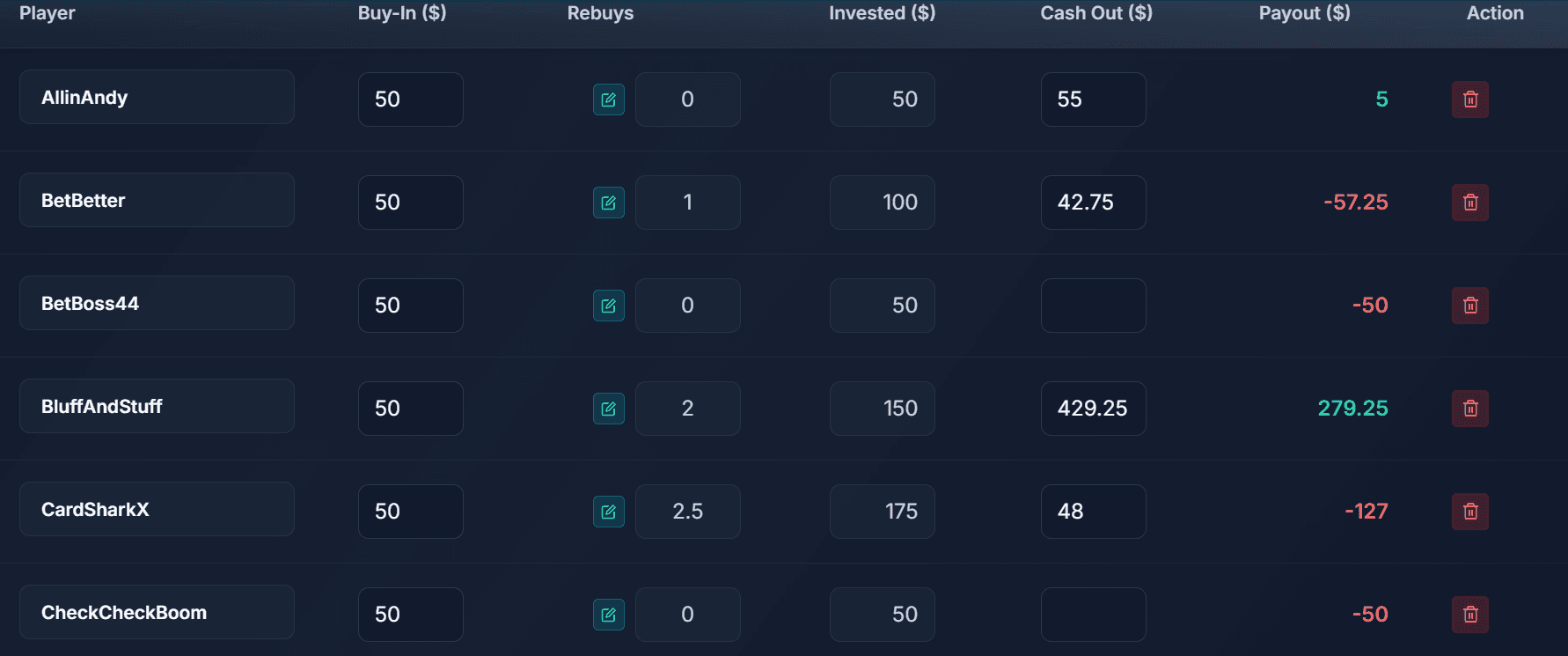
A good poker ledger is simple: record what goes in, record what comes out, then settle the difference.
Money in
Track every buy-in, rebuy, and add-on so the total investment for each player stays accurate.
Money out
Record every cash-out and payout the moment it happens so the final numbers are easy to trust.
Settlement
Use the totals to see who owes whom and close the night with a clean, balanced result.
01
Set the rules
Decide buy-in amounts, rebuy rules, payout timing, and how you will record every payment.
02
Record every buy-in and rebuy
Log money in as it happens so no one has to reconstruct the session from memory later.
03
Record cash-outs
Capture every chip cash-out and payout before players leave the table.
04
Calculate net and settle up
Subtract total buy-ins from the cash-out, then settle the final balances between players.
Formula
Net = Cash-out - Total buy-ins
Buy-ins + rebuys: $120
Cash-out: $170
Net: +$50
Positive net = player should receive money.
Negative net = player owes money.
Common mistakes
- ✓Forgetting to include rebuys or add-ons
- ✓Mixing payment methods without a clear record
- ✓Failing to record partial cash-outs
- ✓Trying to reconcile multiple games from memory
Spreadsheet or Track The Stack?
A spreadsheet can be enough for a simple one-off poker night. Track The Stack is built for recurring games where buy-ins, rebuys, cash-outs, history, standings, and settlement all need to stay organized.
Check = good fit · X = weak fit
One-off game
One banker collecting all money
Multiple rebuys or add-ons
Partial cash-outs
Recurring weekly or monthly game
League standings and player history
End-of-night settlement clarity
Long-term poker group
Built for the games that outgrow a spreadsheet
Built for the games that outgrow a spreadsheet
A spreadsheet can handle a simple poker night. But once your game includes recurring sessions, rebuys, history, standings, and who-owes-who settlement, Track The Stack gives you a cleaner system.
FAQ
How do you track poker buy-ins?
Record each player’s initial buy-in, any rebuys or add-ons, and the payment method used. The cleanest approach is to record each buy-in as it happens instead of trying to recreate the ledger after the game.
How do you calculate poker cash game profit?
Poker cash game profit is calculated by subtracting a player’s total buy-ins from their final cash-out. If a player bought in for $100 and cashed out for $160, their net profit is $60.
Should I track cash-outs or just net profit?
Track cash-outs first. Net profit should be calculated from the cash-out amount minus total buy-ins. This creates a cleaner record and makes disputes easier to resolve.
What is the easiest way to settle a poker night?
The easiest method is to calculate each player’s net result, then have losing players pay winning players using the fewest number of transfers possible.
Is a spreadsheet enough for tracking poker games?
A spreadsheet can work for simple one-off games, but recurring poker groups usually benefit from an app that preserves history, tracks rebuys, calculates results, and helps with settlement.
Related poker tracking guides
Ready to make poker-night accounting easier?
Track buy-ins, rebuys, cash-outs, results, and settlement in one clean session ledger.